Internships in Hong Kong: The Complete 2026 Guide for Students and Recent Graduates

Kenji Farre, Director · Apr 30, 2026 · 8 min read

Quick Answer: What Is an Internship in Hong Kong?
An internship in Hong Kong is a short-term, structured work placement, typically lasting between 8 weeks and 12 months, where a student or early-career professional gains hands-on experience inside a company while still studying or shortly after graduating. In Hong Kong, internships are most commonly offered as:
- Summer internships (June to August), the largest cycle by volume, especially in finance and consulting
- Winter internships (typically December to January or January to March)
- Off-cycle internships (any other time of year, often 3 to 6 months and full-time)
- Year-long industrial placements for students on sandwich degrees
- Virtual internships, where the work is done remotely for a Hong Kong-based employer
Interns in Hong Kong are paid in most professional sectors. Investment banks, large law firms, Big Four accounting firms, and major tech companies typically pay HKD 15,000 to HKD 30,000 per month for summer internships. Smaller startups and NGOs often pay between HKD 8,000 and HKD 14,000 per month, and unpaid academic-credit internships still exist, although they are increasingly rare.
If you are a non-local student, you must hold a valid student visa and a No Objection Letter (NOL) from the Immigration Department before you start. We cover this in detail below.
Why Hong Kong Is One of the World's Best Cities to Intern In
Hong Kong is the financial gateway between mainland China and the rest of the world, the regional headquarters for hundreds of multinationals, and one of the densest professional service hubs in Asia. For an intern, this translates into three things that matter:
- Concentration of opportunity. Central, Admiralty, and Quarry Bay alone host the regional offices of every bulge bracket investment bank, the Big Four, the MBB consulting firms, and most major asset managers. You can walk between three coffee chats in a morning.
- Speed of responsibility. Hong Kong teams tend to be leaner than their New York or London counterparts, which means interns are often given client-facing work, live deal exposure, or production-level code earlier than they would be elsewhere.
- Career optionality after graduation. Non-local students who complete a Hong Kong degree can apply for the Immigration Arrangements for Non-local Graduates (IANG) visa, which is quota-free and gives you 24 months to work in Hong Kong without a sponsor. An internship is often the bridge between a student visa and a full-time return offer that converts to IANG.
Whether you are a CUHK, HKU, HKUST, PolyU, or CityU student, an exchange student, or someone applying from overseas, the internship market in Hong Kong rewards early planning more than almost any other career step.
At ExpatJobBoard.com, there’s dozens of internships for English speakers in Hong Kong. If you're an aspiring intern in Hong Kong, you should definitely check it out.
Types of Internships in Hong Kong
Summer Internships in Hong Kong
The summer cycle is the dominant internship cycle in Hong Kong. Most summer internships run for 8 to 10 weeks between mid-June and mid-August. Summer internships are almost always paid in professional services, target penultimate-year (second-to-last year) undergraduates, and frequently lead to a return offer for a full-time graduate role.
Application timelines for summer 2026 internships have already largely closed at major banks and consultancies, which open applications between June and September of the year before. Summer 2027 application windows for top finance and consulting firms will open in June to September 2026, and for many firms applications are reviewed on a rolling basis, meaning the earlier you apply within the window, the better your odds.
Winter Internships in Hong Kong
Winter internships are shorter, typically 4 to 6 weeks, and they cluster around the December-to-February window between Hong Kong university semesters. They are common at private banks, asset managers, family offices, hedge funds, and tech companies. Winter internships are useful for first-year and second-year students who want to build a CV before the summer recruitment cycle, and they often serve as a feeder into summer programmes the following year.
Off-Cycle Internships in Hong Kong
An off-cycle internship is any internship that does not fall within the structured summer or winter programmes run by large corporates. They are usually 3 to 6 months long, full-time, and start at any point in the year. Investment banks, hedge funds, and crypto firms in Hong Kong rely heavily on off-cycle interns to plug gaps between programme cycles, and they can be the most effective route to a full-time offer for someone who missed the structured cycle. Off-cycle is also the most common format for international students taking a gap semester or a year out.
Virtual and Remote Internships in Hong Kong
Virtual internships are placements where you work for a Hong Kong-based employer without being physically in Hong Kong. They became mainstream during the pandemic and have stuck around in tech, marketing, content, research, and some boutique finance roles. A virtual internship can be a strong option if you cannot get a Hong Kong visa or you want Hong Kong experience on your CV from your home country, but be aware that they tend to pay less than in-person roles and they will not by themselves qualify you for the IANG visa later on.
Industrial Placements and Sandwich Years
A small number of UK and European universities run sandwich-year programmes that let you spend 9 to 12 months at a Hong Kong company between your second and final year of study. PolyU, HKUST, and CUHK also operate Work-Integrated Learning programmes for their own students. These long placements are deeply valued by employers because they show sustained commitment and depth.
Top Industries Hiring Interns in Hong Kong
Investment Banking and Capital Markets
Hong Kong is the largest investment banking hub in Asia outside of mainland China. The bulge bracket firms (Goldman Sachs, Morgan Stanley, JPMorgan, Citi, Bank of America, UBS, Deutsche Bank, HSBC) all run summer analyst programmes in Hong Kong, typically targeting penultimate-year students from a small set of target universities in the US, UK, and Hong Kong. Mandarin fluency is increasingly a hard requirement for IBD, S&T, and especially Wealth Management and Private Banking roles. Pay is the highest in the market: a 2026 summer analyst can expect roughly HKD 25,000 to HKD 35,000 per month plus a meal stipend.
Asset Management, Hedge Funds, and Quant
Firms like BlackRock, Fidelity, PIMCO, Bridgewater, Citadel, Millennium, Point72, Two Sigma, and Jane Street recruit summer and off-cycle interns into Hong Kong. Jane Street is one of the most sought-after employers for technical interns and runs a notoriously selective process focused on probability, mental maths, and trading-game performance. Quant trading and quant research interns at top firms can earn HKD 40,000 to HKD 60,000 per month, the highest pay in the city for an intern.
Big Four and Professional Services
Deloitte, PwC, EY, and KPMG run the largest internship programmes in the city by headcount. They take interns into audit, tax, consulting, advisory, and risk functions, and they hire from a much wider pool of universities than the investment banks. Big Four internships are 6 to 8 weeks, paid between HKD 12,000 and HKD 18,000 per month, and have very high return-offer conversion rates.
Management Consulting
McKinsey, Bain, BCG, Oliver Wyman, Roland Berger, and the Big Four advisory practices all recruit interns into their Hong Kong offices. Internships are usually 8 to 10 weeks for penultimate-year students and pay is broadly in line with investment banking. Mandarin is strongly preferred for client work in Greater China.
Tech, Engineering, and Product
Google, Microsoft, Meta, Apple, Amazon, ByteDance, and Tencent all have engineering or business interns in Hong Kong, although Hong Kong tech offices are smaller than Singapore or Beijing. Local fintech, crypto, and Web3 companies, as well as the in-house tech teams at HKEX and the major banks, are very active intern hirers. Pay ranges from HKD 18,000 to HKD 35,000 per month for engineering interns at top firms.
Law
The major international law firms in Hong Kong (Linklaters, Clifford Chance, Allen & Overy, Freshfields, Latham & Watkins, Skadden, Davis Polk, and others) run vacation schemes that are the primary feeder into training contracts. Vacation schemes are usually 2 to 4 weeks, paid between HKD 15,000 and HKD 20,000 pro-rated, and applications open in the autumn for the following summer.
Luxury, Retail, and Hospitality
LVMH, Richemont, Kering, Estée Lauder, Mandarin Oriental, and the Four Seasons run internship programmes in Hong Kong, often shared with their Greater China headquarters. These tend to be unpaid or modestly paid (HKD 8,000 to HKD 14,000) and focus on marketing, merchandising, retail operations, or hospitality management.
Startups, NGOs, and Family Offices
The boutique end of the market is large and underrated. Small family offices, single-family wealth managers, early-stage startups in Cyberport and HKSTP, and NGOs across the city offer hands-on, unstructured internships where a strong intern can land a full-time offer simply by being indispensable. Pay varies wildly, from unpaid to HKD 20,000 per month.
Top Companies Offering Internships in Hong Kong
The following employers consistently run formal internship programmes in Hong Kong and are good starting points for your application list. Banks: HSBC, Hang Seng Bank, Standard Chartered, Bank of China (Hong Kong), DBS, Citi, JPMorgan, Goldman Sachs, Morgan Stanley, UBS, Deutsche Bank, Bank of America, BNP Paribas, Société Générale. Asset managers and trading firms: BlackRock, Fidelity, PIMCO, Invesco, Schroders, Manulife Investment Management, AIA, Albourne Partners, Jane Street, Citadel, Millennium, Point72, Two Sigma. Big Four and consulting: Deloitte, PwC, EY, KPMG, McKinsey, BCG, Bain, Oliver Wyman, Marsh McLennan, Kroll. Tech: Google, Microsoft, Meta, Apple, Amazon, ByteDance, Tencent, HKEX, bolttech. Law: Linklaters, Clifford Chance, Allen & Overy, Freshfields, Latham & Watkins. Insurance: AIA, Prudential, Manulife, Chubb. Conglomerates: Jardine Matheson, Swire Group, CK Hutchison, MTR Corporation.
The MTR Corporation runs one of the largest non-finance internship programmes in Hong Kong, with placements across engineering, planning, sustainability, finance, and corporate functions. CUHK Career Centre and the equivalent offices at HKU, HKUST, PolyU, and CityU all maintain live job boards with employer-specific intern postings, and they are worth checking weekly.
Intern Pay in Hong Kong
The following table reflects market rates for summer 2026 internships in Hong Kong. Numbers are monthly gross pay before tax (Hong Kong has a flat salaries-tax system and most interns pay little or no tax because their earnings fall under the personal allowance).
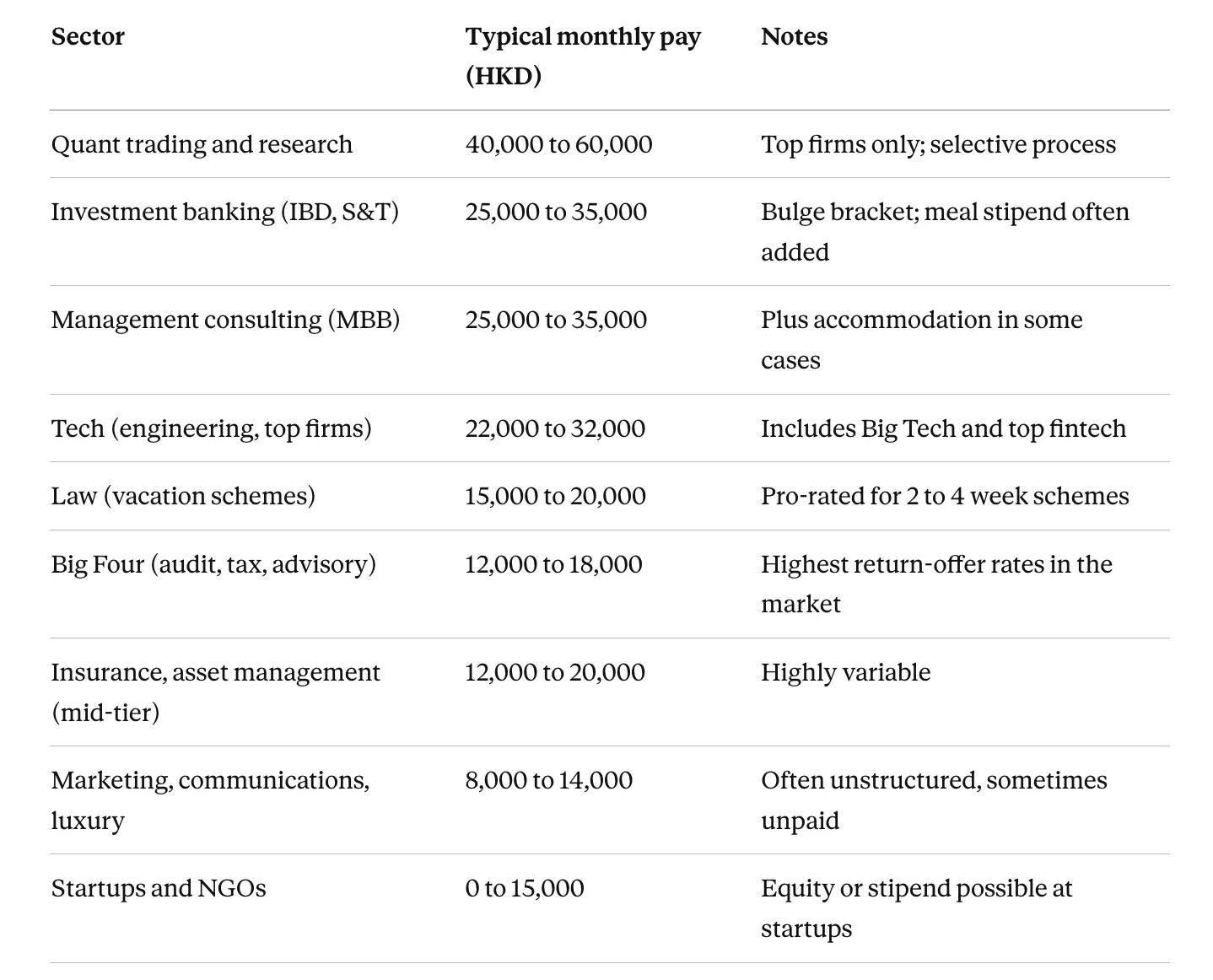
Hong Kong does not have a statutory minimum wage that applies to most student interns, because the Minimum Wage Ordinance contains specific exemptions for student interns and work experience students who are studying in a full-time accredited programme and have signed the Labour Department's Student Intern Declaration. This is why some unpaid internships are still legal in Hong Kong.
Hong Kong Internship Visa Rules
The visa rules for internships in Hong Kong depend entirely on whether you are a local resident, a non-local student already studying in Hong Kong, or someone applying from overseas without any Hong Kong tie. Hong Kong's Immigration Department draws a hard line between these categories and the rules are strict.
If You Are a Hong Kong Permanent Resident or Hold a Hong Kong ID
You can work and intern freely in Hong Kong with no visa restrictions. There is nothing more you need to do.
If You Are a Non-local Student Studying Full-time in Hong Kong
You can take up an internship if you meet the conditions set by the Immigration Department. These are:
- Your programme is a full-time, locally-accredited undergraduate or postgraduate programme of at least one academic year in length.
- The internship is study or curriculum-related and is arranged or endorsed by your university.
- The duration of the internship is up to one academic year, or one-third of the normal duration of your programme, whichever is shorter.
In addition to study-related internships, since 1 November 2024 non-local undergraduate students (and since 1 November 2023, postgraduates) are temporarily exempted from the standard restrictions on part-time and summer employment, meaning you can take up part-time on-campus work during term time and full-time work during the summer (1 June to 31 August) without the usual restrictions on hours and location. This is currently being run as a two-year trial, so check the Immigration Department's current guidance before relying on it.
You will need a No Objection Letter (NOL) from the Immigration Department for any qualifying internship. Your university's career office or international student office handles the application and the NOL is typically free.
If You Are Coming from Overseas Without a Hong Kong Study Visa
This is the hardest path. You will generally need either a Training Visa or an Employment Visa, both of which require the company to sponsor you. Training Visas are issued for up to 12 months and are designed for people learning skills not available in their home country. Employment Visas are for skilled professionals and the company has to demonstrate that the role could not be filled locally. In practice, very few Hong Kong companies sponsor visas for interns who are not already studying in Hong Kong, which is why the realistic overseas paths are either (1) attend a short summer programme run by an organisation like The Intern Group, AIESEC, or a university partner that handles the visa for you, or (2) plan to study in Hong Kong first and then intern as a non-local student.
After Graduation: The IANG Visa
If you graduate from a full-time, locally-accredited Hong Kong undergraduate programme or higher, you can apply for the Immigration Arrangements for Non-local Graduates (IANG) visa within six months of graduation. IANG is quota-free, non-sector-specific, and is initially granted for 24 months without the need for an employer sponsor. This is the visa most international Hong Kong graduates use to take up their first full-time role, and it is one of the strongest reasons to do an internship in Hong Kong while you are still studying there.
Applying for Internships in Hong Kong
Step 1: Build Your CV and LinkedIn for the Hong Kong Market
Hong Kong CVs are typically one page, in English, and emphasise university name, GPA (if 3.4+ on a 4.0 scale), language skills (English, Mandarin, Cantonese), and any quantifiable achievements. Add Mandarin fluency level honestly: HSK 5 or 6 if you have it, otherwise "conversational" or "professional working proficiency". Recruiters in Hong Kong filter heavily on language, so be specific.
Step 2: Apply Early and Apply Wide
For summer 2027 internships, applications at top investment banks and consulting firms will open in June to September 2026, and many close on a rolling basis well before the official deadline. Submit your top 3 applications within the first two weeks of the window opening. Apply to 30 to 50 firms in total across tiers, not 5. Most successful summer analysts submit 40+ applications.
Step 3: Network Through Coffee Chats and Alumni
Networking is more important in Hong Kong than in the US or UK because of how regional and relationship-driven the market is. Use LinkedIn to find alumni from your university working at your target firms, and send a short, specific cold message asking for a 20-minute virtual coffee. Aim for 3 to 5 coffee chats per target firm before submitting your application. The cold email should be 4 sentences: who you are, why this firm specifically, one specific question you cannot answer from public information, and a clear ask for 20 minutes on a video call.
Step 4: Prepare for Online Assessments and Video Interviews
Most large employers use HireVue or pymetrics for first-round screening. Practice on the platform, use a quiet room, and dress as you would for an in-person interview. For finance roles, expect numerical reasoning, situational judgment, and brainteaser-style questions. For consulting, expect case interviews early in the process. For quant and tech, expect coding tests on HackerRank or Codility.
Step 5: Master the Final-Round Superday
The final round at most banks and consultancies in Hong Kong is a "superday" of 3 to 5 back-to-back interviews in one day, usually on-site in Central. Expect a mix of behavioural ("Why Hong Kong, why this firm, why this role"), technical (DCF, comps, accounting for finance; case maths for consulting), and fit interviews. Have 8 to 10 prepared stories that demonstrate leadership, teamwork, failure, conflict, initiative, and analytical work, and rotate them across your interviewers.
Step 6: Convert the Internship into a Return Offer
Once you start, the goal is the return offer. The three things that move the needle most are: (1) ask for feedback in week 2, week 5, and the final week, and act on it visibly; (2) build a relationship with at least one analyst, one associate, and one VP in your team; and (3) deliver one piece of work that exceeds the brief, ideally a piece of analysis your manager did not ask for but obviously needed.
Cold Emailing for an Internship in Hong Kong
If you missed the structured recruiting cycle, cold emailing is the single most effective tool for landing an internship in Hong Kong. The hit rate on a well-written cold email is 10 to 20 percent for a coffee chat, and roughly 1 in 20 coffee chats leads to an interview. Volume and quality both matter.
A good Hong Kong cold email is short, specific, and addressed to a real human you have researched. The structure that works:
- Subject line: "20 minutes about [specific topic] from a [your university] student"
- One sentence introducing yourself and the connection ("I am a CUHK economics junior interested in your team's work on healthcare M&A in Greater China")
- One sentence on why this person specifically ("I read your interview on [podcast/publication] and your point about [specific point] is what made me want to reach out")
- One sentence with the ask ("Would you have 20 minutes for a video call in the next two weeks?")
- One sentence with a calendar offer or a specific time window
Send it from your university email address. Follow up once after 7 working days. Do not follow up a second time. Move on.
FAQs About Internships in Hong Kong
What is an internship?
An internship is a short-term, structured period of work, usually between 4 weeks and 12 months long, where someone (usually a student or recent graduate) works inside a company to gain practical experience in a specific field. Internships in Hong Kong are typically paid in professional sectors and they are the primary way that students convert their academic study into a full-time job offer after graduation.
What is a summer internship in Hong Kong?
A summer internship in Hong Kong is a paid placement of 8 to 10 weeks between mid-June and mid-August, targeted at penultimate-year university students. Summer internships at top banks and consulting firms in Hong Kong have very high return-offer conversion rates and are the dominant route into full-time graduate jobs in finance, consulting, and law.
What is a winter internship?
A winter internship is a shorter placement, usually 4 to 6 weeks, that runs during the December-to-February window between Hong Kong university semesters. They are common at private banks, hedge funds, and tech firms, and are often used by first and second-year students to build a CV before applying to summer programmes the following year.
What is an off-cycle internship?
An off-cycle internship is one that does not fall within the structured summer or winter cycles. Off-cycle internships are typically 3 to 6 months long, full-time, and start at any point in the year. They are most common at investment banks (covering team gaps), hedge funds, and startups, and they are often the most realistic route into a full-time job for someone who missed the structured cycle or is taking a gap semester.
What are virtual internships?
Virtual internships are remote work placements where the intern works from home or anywhere in the world for a Hong Kong-based employer. They became mainstream during the pandemic and remain common in tech, marketing, content, research, and boutique finance. Virtual internships generally pay less than in-person internships and do not by themselves qualify the intern for a Hong Kong post-study work visa.
How do I cold email someone for an internship?
Find a real person at the firm using LinkedIn, write a 4-to-5 sentence email that introduces yourself, explains specifically why this person and this firm, asks for 20 minutes on a video call, and offers a time window. Send from your university email. Follow up once after 7 working days. Avoid generic templates and never send the same email to multiple people at the same firm.
Can international students intern in Hong Kong?
Yes. International students who are studying full-time at a Hong Kong university on a student visa can intern in Hong Kong, subject to obtaining a No Objection Letter from the Immigration Department. International students who are not studying in Hong Kong typically need either a Training Visa or sponsored Employment Visa, both of which are harder to obtain.
Do internships in Hong Kong lead to full-time jobs?
Yes, very frequently. At investment banks, consulting firms, and the Big Four, return-offer rates are typically 60 to 90 percent for interns who perform well. The summer internship is the primary recruitment channel for full-time graduate hiring in most professional sectors in Hong Kong.
What is the best time to apply for a 2026 summer internship in Hong Kong?
Applications for summer 2027 internships at top finance, consulting, and law firms will open in June to September 2026. The best strategy is to have your CV, cover letter, and 2 to 3 short coffee chats lined up before the application window opens, then submit within the first 2 weeks of the window.
Are internships in Hong Kong paid?
Most internships at professional services firms, banks, consulting firms, and major tech companies are paid, with monthly stipends ranging from HKD 12,000 to HKD 35,000 depending on the sector and firm. Internships at startups, NGOs, and some marketing or fashion roles can be unpaid or pay below this range. Hong Kong's Minimum Wage Ordinance contains specific exemptions for student interns enrolled in full-time accredited programmes.
How many internships in Hong Kong are there?
Ahrefs data shows the search term "internship Hong Kong" alone returns over 52,000 keyword variations and "internship" gets approximately 2,700 monthly searches in Hong Kong, an indication of how active and crowded the market is. At any given time, the major job boards in Hong Kong list between 300 and 800 active internship postings, with the largest single concentration in finance and accounting.
Find Your Internship in Hong Kong at ExpatJobBoard
ExpatJobBoard is the only English-only job board built specifically for professionals in Hong Kong, and our internship listings are pulled directly from the official career pages of every major employer in the city. Whether you are looking for a summer internship at HSBC, an off-cycle role at a hedge fund, a winter internship in tech, or a virtual placement that fits around your studies, you can filter by sector, function, and visa-friendliness in one search.