Hong Kong Resume Sample 2026: CV Format, Examples & Recruiter Tips

Kenji Farre, Director · Apr 28, 2026 · 6 min read

Most resume guides written for the Hong Kong market are recycled global templates with a Hong Kong sticker on top. They miss the specific conventions that local recruiters expect, the questions that confuse expat applicants ("do I include a photo? What about my expected salary?"), and the regional differences between how a Hong Kong CV looks versus a US resume or a UK CV.
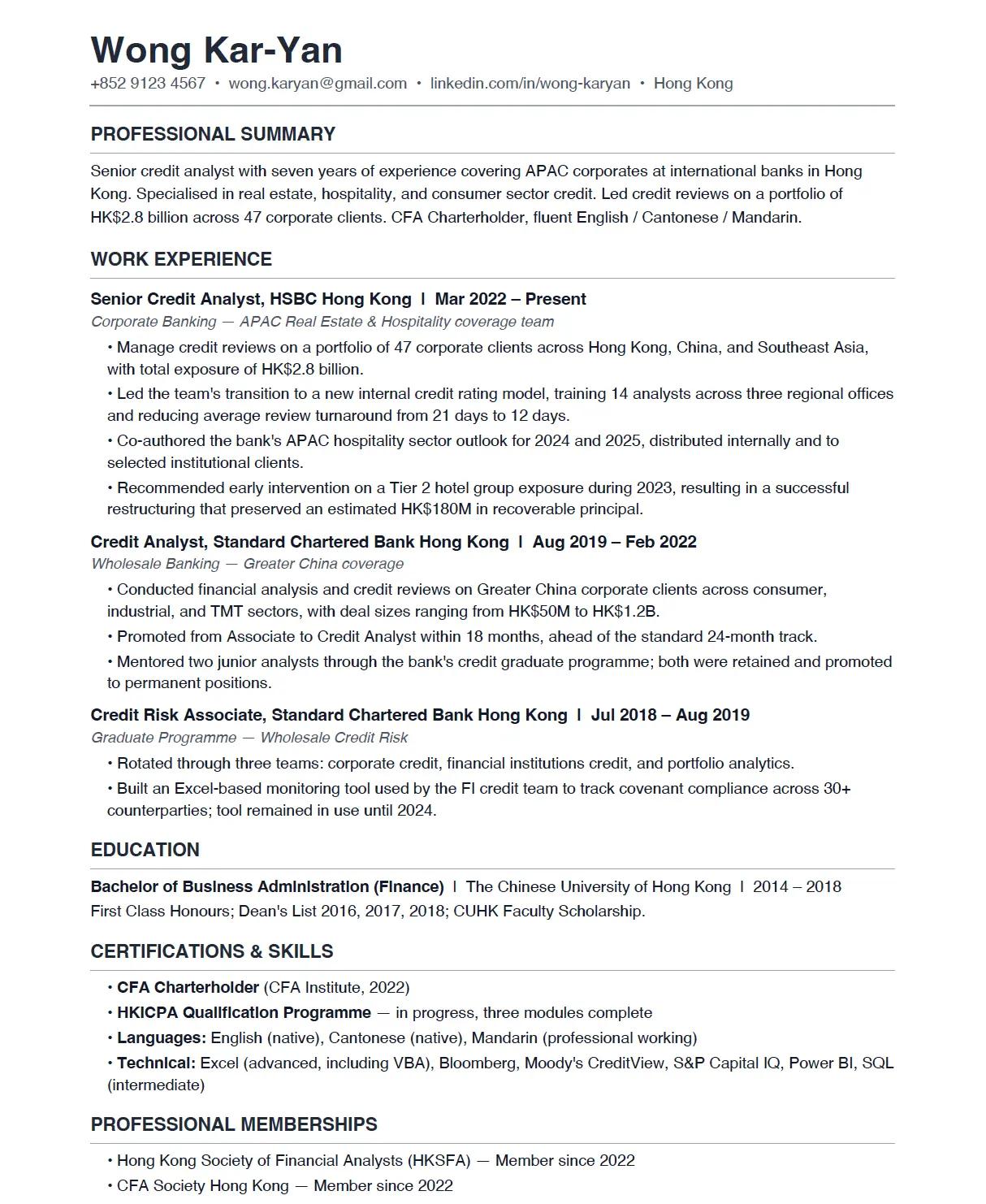
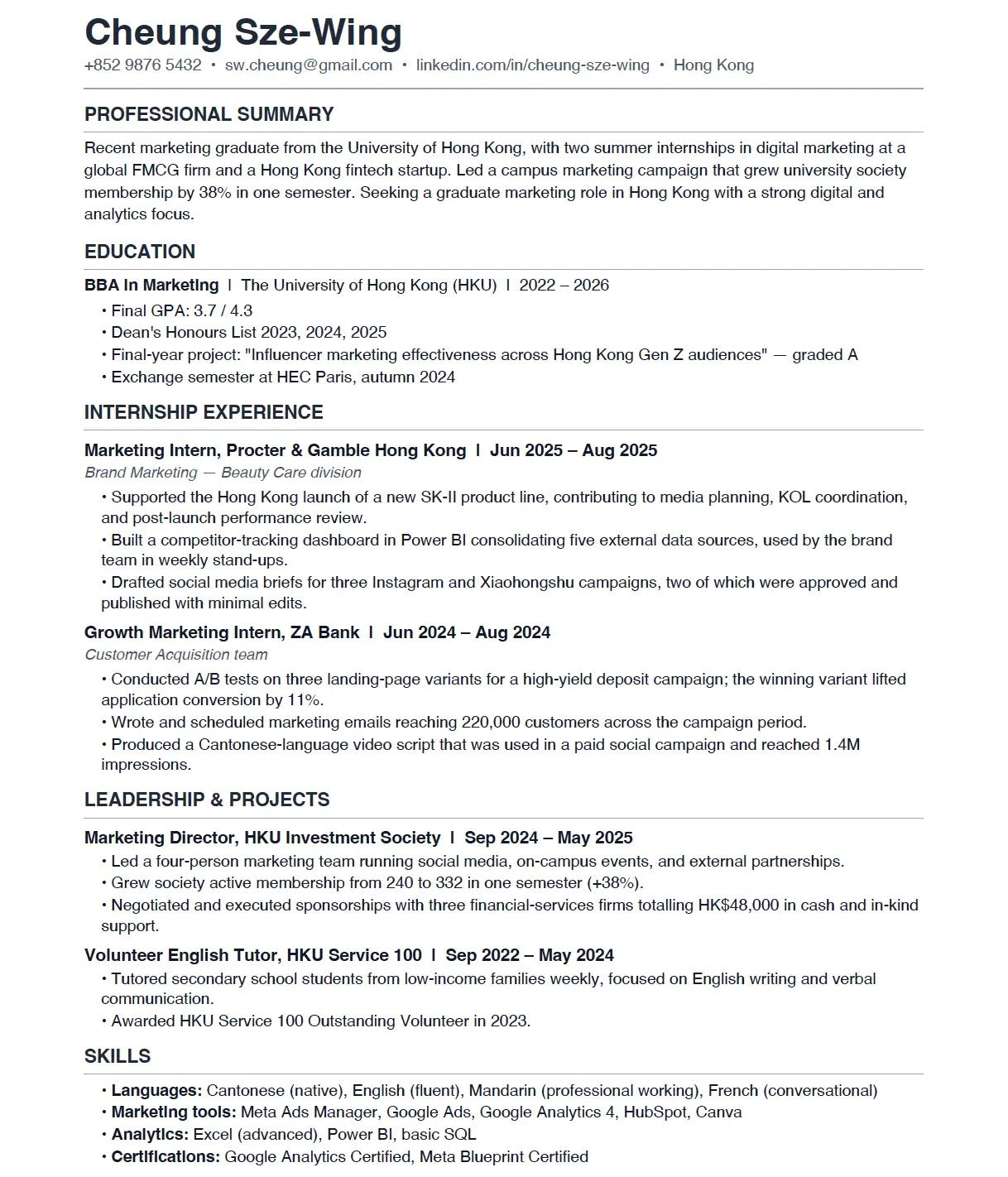
This guide does the opposite. It starts from how Hong Kong recruiters actually screen applications in 2026, walks through the sections in order, and provides two full sample resumes. One for an experienced professional in finance, one for a fresh graduate going into marketing. It also covers the increasingly important question of how to format a CV so it survives the ATS (Applicant Tracking System) software that most large Hong Kong employers now use.
The 30-second version
A Hong Kong CV is normally one page, written in English, in reverse-chronological order. Photos are optional. Expected salary is normally not included on the CV itself — it's asked for separately. Use clear, ATS-friendly formatting (no tables, no graphics, standard fonts), include relevant achievements with metrics, and tailor the CV for each role rather than sending the same one out hundreds of times.
How recruiters actually screen CVs
Before you write anything, understand what's happening on the other side. A typical recruiter at a Hong Kong agency or a corporate HR team in 2026 receives somewhere between 50 and 300 applications per role. They cannot read each CV in detail. The first pass is fast (often six to eight seconds per CV) and is essentially looking for filters:
- Right-to-work status in Hong Kong (HKID holder, work visa, dependent visa, or visa sponsorship needed)
- Years of experience in the relevant function
- Industry background that matches the role
- Language skills (English, Cantonese, Mandarin, others)
- Education credentials at the level the role requires
Anything that doesn't pass these filters is rejected before anyone reads the substance. So the first job of a Hong Kong CV isn't to impress, it's to make these filters effortless to apply. The recruiter shouldn't have to hunt for any of this information.
The second pass, for CVs that survive, is closer to 30 seconds. Here the recruiter is looking for relevance, achievements, and progression. Generic responsibility lists ("managed key client relationships") get scanned and forgotten. Specific, quantified achievements ("grew portfolio AUM from HK$80M to HK$140M over two years across 12 institutional clients") get circled.
The third pass is the human read, which only happens for the eight or ten CVs that have passed the first two. By that point, you've already done most of the work.
The structure of a Hong Kong CV
In order, top to bottom, here's what a CV for the Hong Kong market should contain.
1. Header
Name in larger text at the top. Below it, in smaller text:
- Phone number (with +852 country code if you're applying internationally)
- Email address (a professional one — firstname.lastname@gmail.com, not partygirl1996@hotmail.com)
- LinkedIn URL (customised: linkedin.com/in/firstname-lastname)
- Location (Hong Kong is enough — full home address is not required and is increasingly seen as outdated)
What to leave out:
- HKID number — never on a CV. This is sensitive personal data and you only provide it on the official onboarding paperwork after an offer is signed.
- Date of birth — not standard in Hong Kong CVs in 2026. It used to be common; it isn't now, and including it can introduce age-bias risks.
- Marital status, religion, nationality (unless directly relevant to right-to-work)
- A photo, optionally — see the photo section below
2. Professional summary (2 to 3 lines)
This is not a personal statement, a career objective, or a paragraph about your aspirations. It's a one-paragraph elevator pitch for the role you're applying for, written for the recruiter's six-second scan.
A good summary tells the reader, in this order:
- What you do (your professional identity)
- Your years of experience and core domain
- One or two distinctive strengths or qualifications
- The kind of role you're seeking (only if you're switching directions, otherwise leave this out)
A bad summary:
Highly motivated and detail-oriented professional with strong communication skills seeking opportunities in a dynamic environment.
A good summary:
Senior product manager with eight years of experience building consumer fintech products in Hong Kong and Singapore. Led cross-functional teams of 12+ and shipped a regulated payments product that reached 1.2M users in its first 18 months. CFA Level 2.
The good version uses every word to do work. The bad version uses words to fill space.
3. Work experience (reverse chronological)
This is the section that gets read most carefully. For each role, include:
- Job title, company name, and location on one line
- Dates of employment (month and year), right-aligned or beside the company name
- One line of context describing the company and your remit, especially if the company isn't widely known
- Three to six bullets describing what you did and what you achieved
The bullets are the most important part of your CV, and the most consistently mishandled. The standard template:
[Action verb] + [what you did] + [quantified outcome where possible]
Examples that work:
- "Led a team of six analysts producing weekly equity research notes covering 24 listed companies in the Hong Kong consumer sector"
- "Reduced procurement costs by 14% (HK$3.2M annually) by renegotiating three top-tier supplier contracts"
- "Designed and rolled out a new client onboarding workflow, cutting average onboarding time from 17 days to 6 days across the APAC region"
Examples that don't:
- "Responsible for managing client relationships" (no action, no outcome)
- "Helped with various projects" (vague, low signal)
- "Strong team player who works well under pressure" (assertion, not evidence)
A few specific Hong Kong conventions worth knowing:
- Use action verbs in the past tense for past roles ("Led", "Built", "Launched"). Use the present tense for your current role ("Lead", "Build", "Launch") only if you're still in it.
- Quantify in HKD when relevant. Hong Kong recruiters parse HKD figures faster than USD or GBP, and using local currency signals comfort with the local market.
- Use Hong Kong company names as locals would recognise them. "HSBC" not "HSBC Holdings plc". "PCCW" not "PCCW Limited". Only use the full registered name if it might be confused with another entity.
4. Education
In reverse chronological order, like work experience. For each entry:
- Degree, with major if relevant
- Institution name and location
- Graduation year (or expected graduation year for current students)
- Notable achievements: First Class Honours, Dean's List, scholarships, GPA if exceptional
You don't need to include your secondary school or DSE/A-level results once you have a university degree, unless you're applying for a graduate scheme that specifically asks. For senior roles, you can shorten the education section to a single line per qualification.
5. Skills
A short, scannable section. Group skills by category if it helps:
- Technical: Excel (advanced), Power BI, Python (intermediate), SQL, Salesforce
- Languages: English (native), Cantonese (native), Mandarin (professional working), French (conversational)
- Certifications: CFA Charterholder, PMP, AWS Certified Solutions Architect
Don't pad with generic "skills" like "communication" or "teamwork" — these belong in the work experience section as evidence, not as claims.
6. Optional sections
Depending on the role and your background, consider including:
- Publications or speaking engagements (especially for academic, research, or thought-leadership roles)
- Volunteer work (especially if it demonstrates leadership or skills relevant to the role)
- Professional memberships (HKICPA, HKBA, HKIB, etc.)
- Hobbies or interests, only if they meaningfully differentiate you. "Reading and travel" adds nothing. "Competitive sailing — Hong Kong national team 2018–2020" is interesting and worth including.
The questions every applicant asks
Should I include a photo on my CV?
Hong Kong is one of the markets where including a photo is culturally common but legally optional. Many local CVs include a small, professional headshot in the top right corner. Some don't. There's no universal expectation.
Arguments for including a photo:
- Common in Hong Kong, Mainland China, and much of Asia. Recruiters won't think twice about it.
- For client-facing or front-of-house roles (luxury retail, hospitality, broadcasting), a photo can help.
Arguments against:
- It introduces bias risk for the employer, and some international or compliance-sensitive employers (especially US or UK headquartered firms) prefer no photo.
- It's not standard in many global markets, so if you're applying internationally with the same CV, it can look unusual.
Practical advice: if you're applying primarily to local Hong Kong companies in non-corporate sectors, including a photo is fine. If you're applying to multinationals, banks, or law firms (particularly those with global hiring policies) leave it off. If you do include one, use a recent, professionally lit headshot in formal business attire, not a holiday photo cropped from a group shot.
Should I include my expected salary on the CV?
Generally no. Including your expected salary on the CV itself is uncommon in 2026 and can hurt you both ways. Too high and you screen yourself out before getting to interview, too low and you anchor yourself below your market value.
The exception: some Hong Kong job advertisements specifically ask you to include expected salary in your application. In those cases, put it in your cover letter or email rather than on the CV. Phrase it as a range ("expected monthly salary HK$60,000 to HK$75,000, negotiable based on role and total compensation") rather than a single number.
If you're asked your current salary in interview, that's a separate conversation. You're not legally obliged to disclose it.
Should I include my HKID, date of birth, or marital status?
No to all three.
- HKID is never on a CV. It's sensitive personal data and is only required after you accept an offer.
- Date of birth used to be common in Hong Kong but is no longer standard. Including it introduces age-discrimination risk for the employer, and most companies prefer not to see it.
- Marital status is irrelevant and can be discriminatory for the employer to consider.
If a specific employer asks for any of these on an application form (versus on the CV), that's a different question. But your CV should not include them.
How long should my CV be?
For most professionals in Hong Kong:
- 0–5 years experience: One page
- 5–15 years experience: One pages
- 15+ years or senior roles with publications, board roles, etc.: One to three pages
Don't pad to fill a page. A strong one-page CV beats a stretched-out two-page CV every time. Recruiters notice when you're filling space.
Should I use a CV or a resume?
In Hong Kong, the terms are used interchangeably. "CV" is more common in formal usage and on job ads. The actual document is short and scannable. Closer to what Americans would call a resume than to a multi-page academic CV. Don't worry about the term; worry about the content.
What about Chinese versions?
Most professional roles in Hong Kong, especially in finance, tech, law, and multinational corporations, are advertised in English and expect an English CV. Some local roles, especially in education, government, or local SMEs, may request a Chinese version.
If you're bilingual and applying for roles where Chinese might help, prepare both an English CV and a Traditional Chinese CV (繁體中文). They're not direct translations — Chinese CVs typically have slightly different conventions on personal information disclosure, career objective phrasing, and education detail. Don't run an English CV through Google Translate and call it a Chinese CV.
ATS optimisation for Hong Kong
Most large Hong Kong employers and recruitment agencies in 2026 use Applicant Tracking System (ATS) software to screen incoming CVs. Workday, SAP SuccessFactors, Greenhouse, Lever, and Taleo are all widely used. The ATS parses your CV into structured data and ranks it for relevance.
ATS-friendly formatting rules:
- Use standard fonts: Arial, Calibri, Helvetica, Times New Roman. Avoid creative fonts that ATS parsers may not read.
- Avoid tables, text boxes, and multi-column layouts. These often break ATS parsing. The ATS may read a two-column layout as a single jumbled block.
- Use standard section headings: "Work Experience", "Education", "Skills". Creative headings like "My Journey" or "Where I've Been" can confuse the parser.
- Submit as a Word document or PDF, depending on what the application asks for. PDF is generally safer in 2026. Modern ATS parses PDF well, and Word documents can have formatting issues across versions.
- Use keywords from the job description. If the role asks for "stakeholder management", use the phrase "stakeholder management" in your CV. Not "stakeholder engagement" or "managing stakeholders". ATS scoring is keyword-literal.
- Avoid headers and footers for important content. Some ATS parsers ignore content in headers and footers entirely. Put your contact information in the body.
- No graphics, charts, or icons. Pretty CVs designed in Canva or Figma may look striking to humans, but they often score poorly in ATS systems and can be rejected before a recruiter ever sees them.
If you're applying through a Hong Kong recruitment agency directly (Hays, Robert Walters, Michael Page, Robert Half), they may have their own intake forms and the ATS layer is less of a concern. If you're applying directly to a corporate careers portal, ATS optimisation matters a lot.
Sample CV 1: Mid-career finance professional
Sample CV 2: Fresh graduate going into marketing
Common resume mistakes
Generic objectives: "Seeking a challenging role in a dynamic environment" tells the recruiter nothing and signals that you've copy-pasted from a template.
Listing responsibilities, not achievements: "Responsible for managing the team" is a job description. "Led a team of six and grew unit revenue 22% YoY" is a CV bullet.
No quantification: Numbers anchor your achievements. If everything in your CV is qualitative, the recruiter has no way to compare you to other candidates objectively.
Mismatched language: Hong Kong recruiters mostly read in English, but they expect British English spelling (organise, recognise, programme (not organize, recognize, program). For multinational US-headquartered employers, US spelling is fine. Be consistent within the document.
Inappropriate email addresses: Use a professional email firstname.lastname@gmail.com works fine. Anything cute, ironic, or holdover from secondary school looks bad.
Outdated LinkedIn URLs: If your CV says linkedin.com/in/cheung-sze-wing-7a28b6f9, customise it. Customisation takes 30 seconds and signals attention to detail.
Lying about language proficiency:"Fluent" Mandarin when you can barely order food will collapse on the first phone screen. Use the standard categories: Native / Fluent / Professional working / Conversational / Basic. Be honest.
Sending the same CV everywhere: Tailor for each role. At minimum, swap in keywords from the job description and adjust the professional summary. The Hong Kong market is small enough that recruiters compare notes; sending boilerplate everywhere is noticed.
Tailoring your CV for the HK market if you're new to the city
If you're moving to Hong Kong from another market, a few specific adjustments to make:
- Convert salary references to HKD if you mention compensation anywhere (usually you don't on the CV itself, but if you do, HKD is expected).
- Translate education credentials into globally recognisable formats. "First Class Honours" is well understood; "Distinction grade GPA" may not be. List your degree, institution, and class of honours — recruiters will look up the equivalence if needed.
- Mention your right-to-work status if you have one. "Hong Kong dependent visa holder" or "Top Talent Pass Scheme" near the top of the CV (in the header line) saves the recruiter a question. If you require visa sponsorship, that's also worth flagging — sponsoring employers will look for it; non-sponsoring employers won't waste time on you.
- Localise company names where helpful. If you worked at a regional bank that the Hong Kong market won't recognise, add a line of context: "Bank of XYZ — Tier 1 retail bank in [country], top three by deposits".
- Adjust expectations on photo and education detail. Photos are more common in HK than in the UK or US. Detailed academic results are more common than in the US.
A final thought
A Hong Kong CV is a professional document, not a creative one. The job is to make it easy for the recruiter to say yes. By passing the filters, by showing relevant experience, by quantifying achievements, and by being formatted in a way that survives both the human scan and the ATS parser. Most CVs fail not because the candidate isn't strong, but because the document doesn't communicate the strength clearly. Get the structure right and you'll outperform the majority of the applicant pool before the recruiter has read a word of substance.
Looking for your next role? Browse curated, English-only roles for professionals in Hong Kong on ExpatJobBoard.com. including remote, hybrid, and in-office positions across finance, tech, marketing, and more.


