Hong Kong Employment Ordinance 2026: 468 Rule, Holidays & Severance

Kenji Farre, Director · May 5, 2026 · 8 min read

The Employment Ordinance (Cap. 57), often abbreviated as EO, is the primary law governing the employment relationship in Hong Kong. Whether you are an employee checking your rights, an employer trying to stay compliant, or someone considering a job offer in Hong Kong, this guide explains every key provision in plain English, with all 2026 updates included.
This is the most current and complete English-language overview available. We cover the new "468 rule," the increase in statutory holidays to 15 days, the higher statutory minimum wage, MPF offsetting abolition, severance rules, annual leave, sickness allowance, maternity and paternity leave, and termination procedures.
What Is the Employment Ordinance?
The Employment Ordinance (EO) is Chapter 57 of the Laws of Hong Kong. It came into operation on 27 September 1968 and has been amended dozens of times since. It is the single most important piece of employment legislation in Hong Kong and applies to every employee under a contract of employment, with very narrow exceptions (family members in family businesses, certain merchant seamen, apprentices under separate ordinances).
You can read the full text at: https://www.elegislation.gov.hk/hk/cap57
The EO is administered and enforced by the Labour Department of the Hong Kong SAR Government.
Quick Answer: What Does the Employment Ordinance Cover?
The EO sets the minimum statutory standards for:
- Wages, payment of wages, and deductions
- Rest days, statutory holidays, paid annual leave
- Sickness allowance
- Maternity leave (14 weeks paid) and paternity leave (5 days paid)
- Severance payment and long service payment
- Employment protection (against unreasonable dismissal)
- Termination notice and payment in lieu of notice
- End of year payment
It also creates the legal concept of a "continuous contract" (now subject to the new 468 rule from 18 January 2026), which is the gateway to most statutory benefits.
The Continuous Contract Test
For decades, the "418 rule" governed continuous contracts: 4 consecutive weeks at 18+ hours per week with the same employer.
From 18 January 2026, the Employment (Amendment) Ordinance 2025 replaced this with the 468 rule:
You are employed under a continuous contract if you have been employed by the same employer for 4 weeks or more, AND either:
- You worked 17 hours or more in each week, OR
- (If any week falls below 17 hours) you worked 68 hours or more across that week and the 3 preceding weeks
This change is significant because it closes the loophole where employers could deliberately schedule someone below 18 hours in a single week to break continuity. Around 10,000 additional workers, mainly part time and casual employees in retail, F&B, and the platform economy, now qualify for statutory benefits.
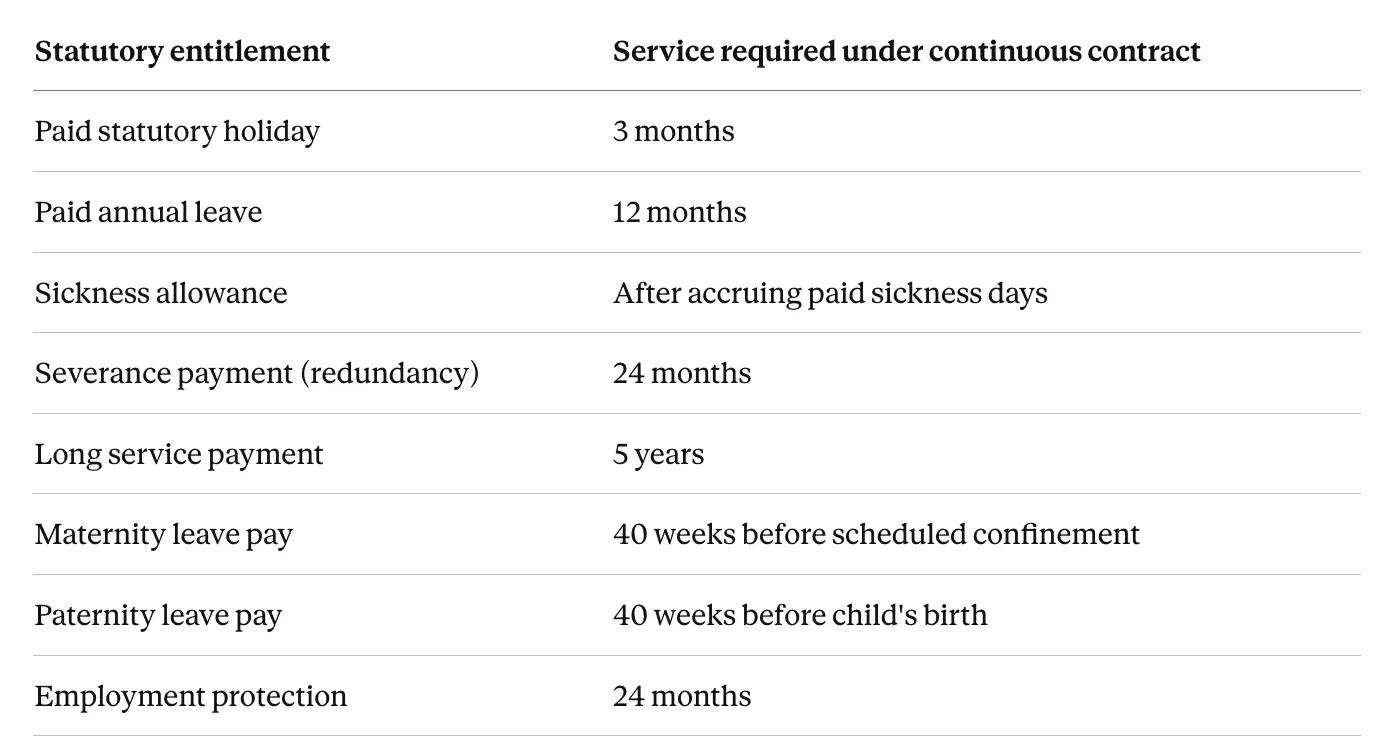
Why does the continuous contract matter?
The continuous contract is the threshold for most EO benefits:
Who Does the Employment Ordinance Apply To?
The EO applies to every employee engaged under a contract of employment, with the following exclusions:
- Family members employed in a family business where all members live in the same dwelling
- Domestic servants employed by a relative
- Persons serving under specified ordinances (e.g., Apprenticeship Ordinance, Merchant Shipping Ordinance)
- Employees of the government in certain capacities
Foreign domestic helpers (FDHs) are covered by the EO except for the statutory minimum wage. They are governed instead by the Standard Employment Contract and the Minimum Allowable Wage.
Wages and Payment Rules Under the EO
When wages must be paid
Wages must be paid within 7 days after the end of the wage period. Beyond 7 days late, the employer is liable for interest. Beyond 1 month late, the employee may treat the contract as terminated by the employer and claim termination payments.
What counts as wages
"Wages" includes basic salary, commission, attendance bonus, overtime pay, and other guaranteed payments. It does NOT include:
- End of year payment (counted separately)
- Tips and gratuities not channelled through the employer
- Allowances of a non-contractual nature
- Reimbursements
- Severance, long service, or holiday pay (separate categories)
Lawful deductions
An employer may only deduct from wages in narrowly defined circumstances:
- Absence from work
- Goods or services damaged or lost (capped at HK$300 per incident; total deductions capped at 25% of wages in the period)
- MPF contributions
- Loans recovered with employee's written consent
- Court orders or statutory obligations
Any other deduction is unlawful and a criminal offence punishable by fine of up to HK$100,000 and imprisonment for up to 1 year.
Statutory Holidays Under the EO
From 1 January 2026, the number of statutory holidays in Hong Kong increased from 14 to 15 days, with the addition of Easter Monday (6 April 2026).
Hong Kong Statutory Holidays 2026
- The first day of January (1 Jan)
- Lunar New Year's Day (17 Feb)
- The second day of Lunar New Year (18 Feb)
- The third day of Lunar New Year (19 Feb)
- Ching Ming Festival (5 Apr, falls on Sunday; substitute on 7 Apr)
- Easter Monday (6 Apr), newly added in 2026
- Labour Day (1 May)
- Birthday of the Buddha (24 May, falls on Sunday; substitute on 25 May)
- Tuen Ng Festival (19 Jun)
- HKSAR Establishment Day (1 Jul)
- The day following Mid-Autumn Festival (26 Sep)
- National Day (1 Oct)
- Chung Yeung Festival (18 Oct, falls on Sunday; substitute on 19 Oct)
- Chinese Winter Solstice OR Christmas Day (employer's choice)
- The first weekday after Christmas (26 Dec, if Winter Solstice chosen instead)
The total will rise to 17 statutory holidays by 2030 under the phased expansion, bringing them in line with general (public) holidays.
Holiday pay rules
- All employees are entitled to statutory holidays regardless of length of service
- Employees with 3+ months continuous contract are entitled to paid holidays
- Holiday pay = average daily wages over the preceding 12 months (or actual period of employment if shorter)
- Employers cannot pay employees in lieu of statutory holidays; they must grant the day off (or an alternative day within 60 days if the employee works on the holiday)
- If a statutory holiday falls on a rest day, the employer must grant an alternative holiday on the next non-rest, non-holiday day
Statutory holidays vs general holidays
- Statutory holidays (15 in 2026): Mandatory under the EO; minimum entitlement for all employees
- General (public) holidays (17 in 2026): Mandatory only for banks, schools, government, and offices observing the General Holidays Ordinance; many white-collar private employers offer these contractually
Annual Leave Under the EO
Once you complete 12 months under a continuous contract, you accrue paid annual leave:
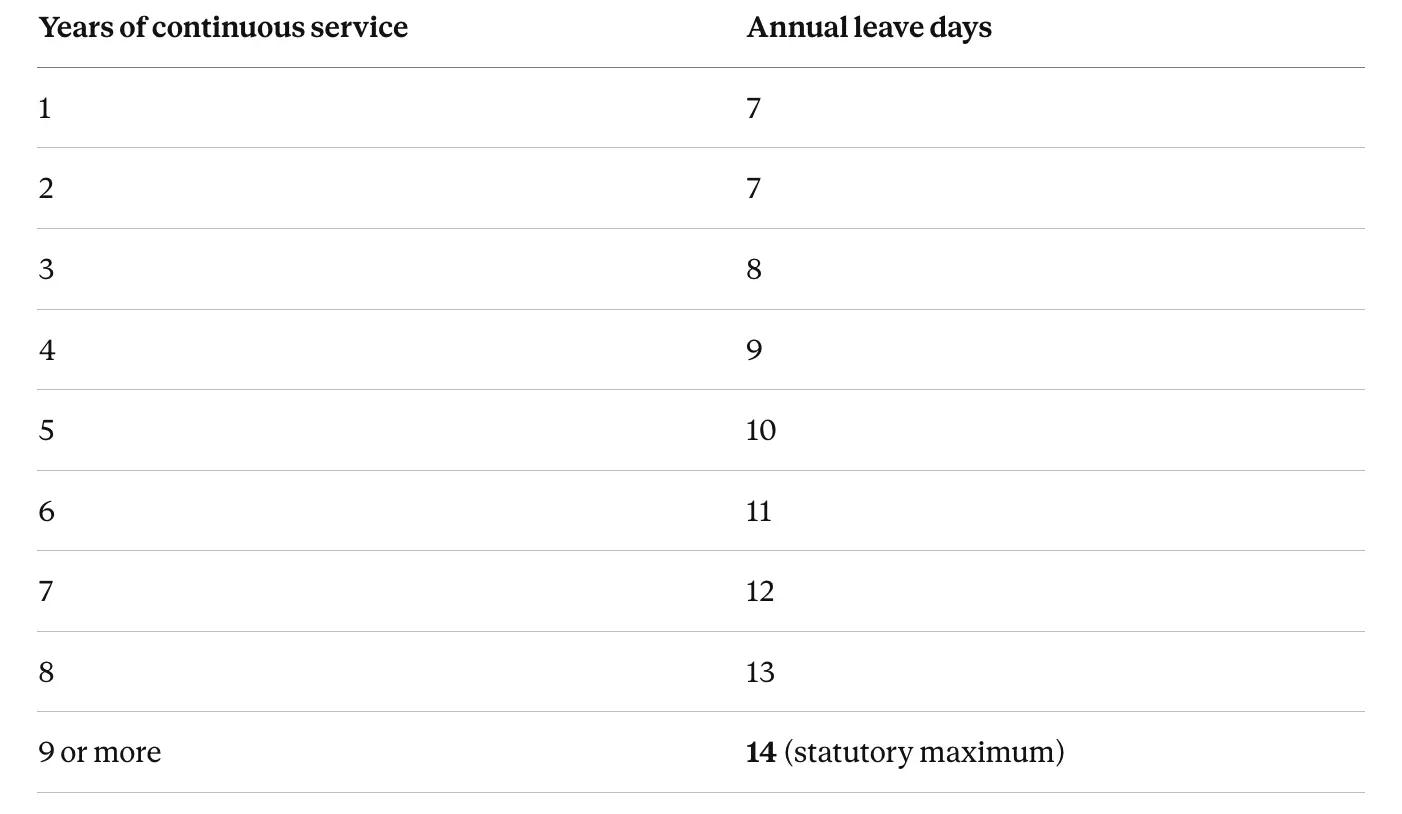
Many employers offer more generous contractual annual leave (15 to 25 days for white-collar professional roles), but 14 days is the statutory ceiling.
Annual leave pay
Annual leave pay = average daily wages over the preceding 12 months. It must be paid no later than the regular payday after the leave ends.
Encashment
Annual leave above the statutory 7 days can be encashed by mutual agreement; the first 7 days must be taken as actual leave.
Sickness Allowance Under the EO (Cap. 57)
Eligible employees accrue paid sickness days at:
- 2 days per month in the first 12 months of continuous employment
- 4 days per month thereafter
- Maximum accumulation: 120 days
To claim sickness allowance:
- The sick day must be a "paid sickness day" (4+ consecutive days of sickness, supported by appropriate medical certificate; OR 1 to 3 days for follow-up specialist consultations or pregnancy check-ups under specific conditions)
- Sickness allowance = 80% of average daily wages over the preceding 12 months
Protection from dismissal during sick leave
An employer cannot dismiss an employee on a paid sickness day, except for serious misconduct. Doing so triggers compensation equivalent to 7 days' wages plus the unpaid sickness allowance for that day.
Maternity and Paternity Leave Under the EO
Maternity leave
- 14 weeks of paid maternity leave (since the 2020 amendment extended it from 10 weeks)
- Maternity leave pay = 80% of average daily wages
- Eligibility: 40 weeks of continuous contract before the scheduled date of confinement
- The Government Reimbursement Scheme reimburses employers for the additional 4 weeks (weeks 11 to 14) up to a cap
Paternity leave
- 5 days of paid paternity leave
- Paternity leave pay = 80% of average daily wages
- Eligibility: 40 weeks of continuous contract before the child's birth
Severance Payment and Long Service Payment
Severance payment (redundancy)
Triggered when an employee is dismissed by reason of redundancy or laid off, with at least 24 months of continuous service.
Calculation: (last month's wages × 2/3) × number of years of service, capped at HK$390,000.
Long service payment
Triggered when an employee with 5+ years of continuous service is dismissed (other than by serious misconduct or redundancy), retires at age 65+, dies, or is certified permanently unfit.
Same calculation method as severance, capped at HK$390,000.
MPF offsetting abolition
Until 1 May 2025, employers could offset severance and long service payments against accrued MPF employer contributions. From 1 May 2025 onwards, this is abolished for service accrued after the transition date. Service accrued before 1 May 2025 retains the offsetting arrangement under transitional rules.
This is one of the most significant changes in Hong Kong employment law in decades, and 2026 is the first full year of operation under the new regime.
Termination of Employment Under the EO
Notice periods
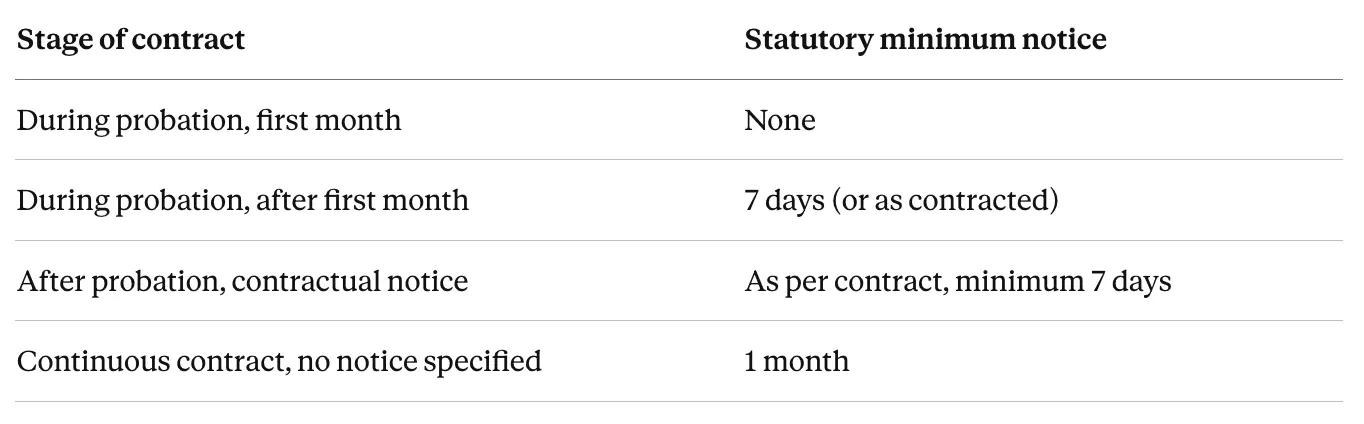
Payment in lieu of notice (PILON)
Either party may terminate immediately by paying the other a sum equal to the wages that would have accrued during the notice period.
Summary dismissal
An employer may dismiss without notice or PILON only for serious misconduct, namely:
- Wilful disobedience of lawful and reasonable orders
- Misconduct (inconsistent with the duties of the role)
- Fraud or dishonesty
- Habitual neglect of duty
- Other grounds entitling termination at common law
Summary dismissal is a high bar; if the employee disputes it, the burden of proof is on the employer.
Employment protection
Employees with 24+ months of continuous contract who are dismissed without "valid reasons" can claim under Part VIA of the EO. Valid reasons are:
- Conduct of the employee
- Capability or qualifications
- Redundancy or other genuine operational requirements
- Statutory requirement
- Other substantial reasons
If no valid reason exists, the Labour Tribunal may order reinstatement, re-engagement, or terminal payments and an award of up to HK$150,000.
What If My Employer Fails to Pay?
The EO is enforced criminally. Wilful failure to pay wages within 7 days of the end of the wage period is an offence:
- Maximum fine: HK$350,000
- Maximum imprisonment: 3 years
Where wages remain unpaid for more than 1 month, an employee may:
- File a claim with the Labour Department
- Apply to the Minor Employment Claims Adjudication Board (claims under HK$8,000 per claimant) or the Labour Tribunal (larger claims)
- In extreme cases, seek bankruptcy proceedings against the employer
The Protection of Wages on Insolvency Fund offers ex gratia payments to employees of insolvent employers, covering wages, severance, and certain other entitlements.
Other Key Updates to the Employment Ordinance
Increased Statutory Minimum Wage
From 1 May 2026: HK$43.10 per hour (up from HK$42.10). Now reviewed annually.
Higher monthly wage threshold for hours record-keeping
From 1 May 2026: HK$17,600 per month (up from HK$17,200). Below this threshold, employers must keep written records of hours worked.
Phased expansion of statutory holidays
Reaching 17 statutory holidays by 2030, matching general holidays. Easter Monday added in 2026; future additions in 2028 and 2030.
EO Hong Kong FAQs
What is employment ordinance Hong Kong?
The Employment Ordinance (Cap. 57) is the primary law governing employment relationships in Hong Kong. It sets minimum statutory standards for wages, working hours, holidays, leave, severance, and termination, and applies to every employee under a contract of employment, with very narrow exceptions.
What is the EO in Hong Kong?
EO is the standard abbreviation for the Employment Ordinance (Cap. 57), the main employment law in Hong Kong. The EO is administered by the Labour Department.
What does the Employment Ordinance Hong Kong cover?
The EO covers wages, payment of wages, lawful deductions, rest days, statutory holidays, annual leave, sickness allowance, maternity leave (14 weeks), paternity leave (5 days), severance payment, long service payment, employment protection against unreasonable dismissal, and termination notice requirements.
What is the 468 rule under the Employment Ordinance?
The 468 rule, effective 18 January 2026, defines a continuous contract as 4+ weeks of employment with either 17+ hours per week or a cumulative 68+ hours over any 4-week period. It replaced the old 418 rule and broadens statutory protections to part time and irregular-hours workers.
How many statutory holidays are there in Hong Kong in 2026?
15 statutory holidays in 2026 (up from 14 in 2025), with Easter Monday (6 April) added under the Employment (Amendment) Ordinance 2021. The number will rise to 17 by 2030.
How does annual leave work under the Employment Ordinance?
After 12 months of continuous contract, you accrue paid annual leave starting at 7 days per year, increasing by 1 day per year of service to a statutory maximum of 14 days at 9+ years.
Is severance payment mandatory in Hong Kong?
Severance payment is mandatory under the EO when an employee with 24+ months of continuous contract is dismissed by reason of redundancy or laid off. The calculation is (last month's wages × 2/3) × years of service, capped at HK$390,000.
What is the minimum wage under the Employment Ordinance?
The Statutory Minimum Wage is set by the separate Minimum Wage Ordinance (Cap. 608), not the EO itself. From 1 May 2026, the rate is HK$43.10 per hour.
What is hong kong employment ordinance annual leave entitlement?
Paid annual leave under the EO starts at 7 days after 1 year of continuous contract, increasing by 1 day per year to 14 days at 9 or more years of continuous service. The first 7 days must be taken as leave; days above 7 may be encashed by mutual agreement.
What is hk employment ordinance sick leave?
Under the Employment Ordinance, employees accrue 2 paid sickness days per month in the first 12 months of continuous employment, then 4 days per month thereafter, up to 120 days. Sickness allowance is 80% of average daily wages, payable for "paid sickness days" supported by medical certificates.
Can my employer dismiss me without notice in Hong Kong?
Only for serious misconduct (wilful disobedience, misconduct, fraud or dishonesty, habitual neglect of duty, or other common-law grounds). Otherwise, statutory or contractual notice (or payment in lieu) is required.
How is severance payment calculated in Hong Kong?
Severance = (last full month's wages × 2/3) × years of continuous service, capped at HK$390,000. Both the wages component and years of service are subject to specific calculation rules under the EO.
Does the EO apply to part time employees?
Yes. The EO applies to all employees regardless of full time or part time status. However, many statutory benefits (paid holidays, annual leave, severance) require a continuous contract, which from 18 January 2026 is governed by the 468 rule.
Where to Get Official Information
- Labour Department EO portal: https://www.labour.gov.hk/eng/legislat/contentB.htm
- Full Ordinance text (Cap. 57): https://www.elegislation.gov.hk/hk/cap57
- Concise Guide to the Employment Ordinance: Free download from the Labour Department website
- Labour Tribunal (for disputes): https://www.judiciary.hk
Final Thought
The Employment Ordinance has been amended more frequently in the past 24 months than at any point in the previous decade. The 468 rule, the higher minimum wage, the additional statutory holiday, and the abolition of MPF offsetting collectively represent a substantial strengthening of employee protections. If you have not reviewed your contract or HR policies in the last year, now is the time.
If you are searching for a job in Hong Kong, particularly one that does not require Cantonese or Mandarin, browse the latest openings on ExpatJobBoard.com. Every employer listing on the platform must commit to compliance with the Employment Ordinance, the Minimum Wage Ordinance, and the MPF Schemes Ordinance.


